What ACMV Installation Covers
ACMV installation is the process of supplying, installing, and commissioning the Air Conditioning and Mechanical Ventilation systems in a building. In Singapore, this is carried out by a licensed ACMV contractor registered with the BCA, and must comply with SS 553 — the Code of Practice for Air-Conditioning and Mechanical Ventilation in Buildings.
A complete ACMV installation typically covers:
- Chilled water plant — chillers, cooling towers, condenser and chilled water pumps, expansion vessels, and insulated pipework distribution throughout the building.
- Air handling units (AHUs) — supply, installation, and ductwork connection for AHUs serving lobbies, corridors, and large spaces.
- Fan coil units (FCUs) — supply and installation of FCUs in individual rooms and tenanted spaces, including pipework connections, drain pans, and thermostats.
- Ductwork and diffusers — fabrication and installation of supply and return air ductwork, grilles, and diffusers throughout the building.
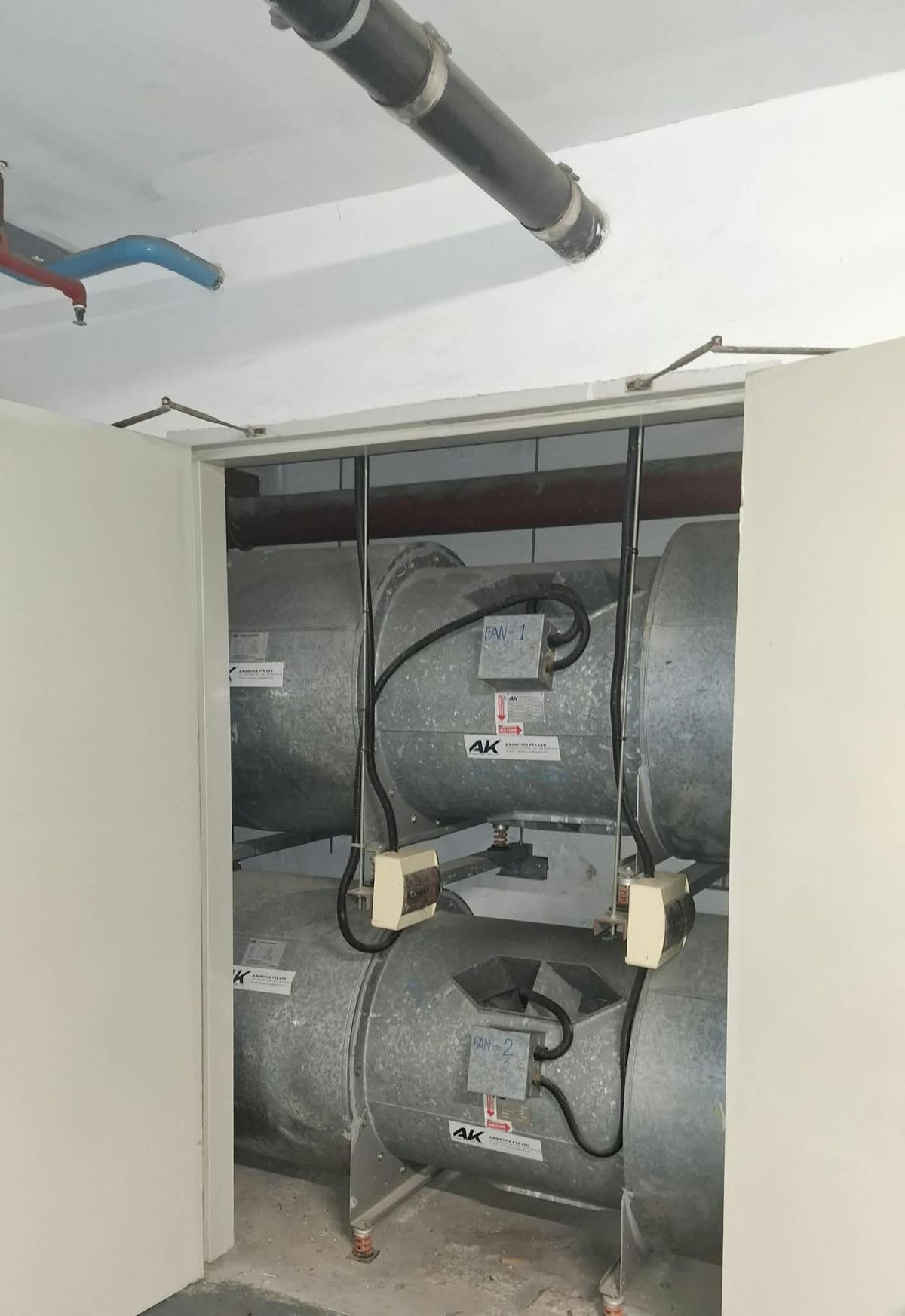
- Mechanical ventilation systems — fresh air supply, exhaust fans, toilet and pantry ventilation, pressurisation, and smoke control systems required by BCA and SCDF. Read more on our ventilation contractor page.
- BMS integration — connection of all ACMV equipment to the building management system for centralised monitoring and control.
- Commissioning and testing — SS 553-compliant testing of the complete system, including airflow balancing, temperature and humidity verification, and BMS point checking.
The ACMV Installation Process in Singapore
Understanding the installation sequence helps building owners and project managers plan their programme and know what to expect at each stage.
Design & BCA Submission
Before installation begins, the ACMV contractor produces engineering drawings — cooling load calculations, equipment schedules, ductwork layouts, and BMS schematics. For buildings requiring a building permit, these are submitted to BCA for approval. Works cannot begin until BCA approves the submission.
Rough-In Works
The first on-site phase covers all works that must be done before walls and ceilings are closed — condenser water and chilled water pipework, refrigerant piping, drain piping, ductwork main runs, and conduit for BMS cabling. Coordination with structural, electrical, and plumbing trades is critical at this stage to avoid clashes.
Equipment Installation
With pipework and ductwork in place, major equipment is installed — chillers and cooling towers on the plant deck, AHUs in plant rooms or above ceiling, FCUs above ceiling tiles or in fan coil enclosures. BMS panels and controls are installed and wired.
Fit-Out & Connections
Diffusers, grilles, thermostats, and access panels are installed. All pipework connections are pressure-tested and inspected. Refrigerant is charged and leak-tested. Drain connections are verified and flushed.
Commissioning & Testing
The full system is commissioned to SS 553 requirements — chillers are started and performance-tested, AHU and FCU airflows are measured and balanced, BMS points are verified, and temperature and humidity set points are calibrated. This phase produces the commissioning records required for BCA handover.
Handover Documentation
At handover, the contractor provides as-built drawings, O&M manuals, equipment warranties, SS 553 commissioning records, and BCA completion documentation. These are your evidence of compliant installation and your reference for future maintenance.
Winsteam Engineering has designed, installed and maintained ACMV systems in Singapore since 1994 — for hotels, data centres, factories and offices. See our ACMV contractor services, read about maintenance contracts, or request a free site survey.
New-Build vs Retrofit Installation: Key Differences
The installation process differs significantly depending on whether you're fitting a new building or replacing an existing system.
- New-build installation runs parallel with the construction programme. Access is relatively unconstrained, works can be properly sequenced with other M&E trades, and there is no existing system to decommission or work around. The main challenge is coordination with structural, architectural, and other M&E contractors to avoid clashes and delays.
- Retrofit installation in an occupied building is more complex. The building must remain operational, existing systems must be decommissioned carefully, access is constrained by finished ceilings and walls, and works must be phased to minimise disruption. In hotels, offices, and factories, this requires detailed planning around occupancy schedules and often means working in sections or outside business hours.
Always ask your ACMV contractor for a detailed works programme and method statement before mobilisation. A well-planned retrofit protects building occupants and revenue; a poorly planned one causes disruption, complaints, and delays. Read our guide on choosing an ACMV contractor for what to look for.
BCA Requirements for ACMV Installation in Singapore
All ACMV installation in Singapore must comply with the Building Control Act, BCA regulations, and SS 553. Key requirements:
- Licensed contractor — all notifiable ACMV installation works must be carried out by a BCA-registered ACMV contractor. Verify on bca.gov.sg before appointing anyone.
- Qualified Person (QP) — significant ACMV installation for commercial buildings typically requires a registered Professional Engineer (PE) as the Qualified Person for M&E works. The QP supervises the works and certifies compliance.
- BCA submission — installation works that form part of a building requiring a building permit require BCA submission drawings to be approved before works begin.
- SS 553 commissioning records — at handover, the contractor must provide commissioning and testing records demonstrating the system was installed and tested to SS 553 requirements.
How Long Does ACMV Installation Take?
- Single FCU — a few hours including testing.
- Floor-by-floor FCU installation (e.g., office fit-out) — days to weeks depending on floor size.
- AHU installation (single unit) — 1–3 days including duct connections and commissioning.
- Chilled water plant installation — weeks to months depending on size; larger systems may take 3–6 months for full plant commissioning.
- Full new-build ACMV system — typically 6–18 months running parallel with the construction programme.
Winsteam Engineering has been delivering ACMV installation across Singapore since 1994 — for hotels, commercial offices, factories, data centres, and pharmaceutical facilities. Learn more about our ACMV services or contact us for a site survey and quotation.